Evidence
Introduction
Dear Music Lover,
Thank you for your decision to acquire these very special Dynaudio Evidence loudspeakers.
They feature advanced Dynaudio loudspeaker technology, resulting in music reproduction at a very high level, making many familiar recordings a new listening experience altogether. This technology results from many years of intense research and development, the highest quality standards in production, and Dynaudio’s enduring passion for musical truth.
Dynaudio is one of very few companies who can realize such loudspeaker concepts through its own in-house development and production facilities. These facilities are so advanced and the quality control is so strict that Dynaudio is TS16949 certified.
Each loudspeaker is constructed by Dynaudio’s master craftsmen in Denmark to these high standards of quality. To realize the highest sound quality from the loudspeakers, some areas should be addressed, as will be explored on the following pages. By considering the tips and suggestions, you will achieve the maximum performance and enjoyment of the loudspeaker and its advanced musical capabilities for a long time to come.
Please also visit our web site www.dynaudio.com. You will find additional information:
- Dynaudio dealers in your area
- Questions and answers about Dynaudio products and technical information
- Dynaudio events and news
We wish you many years of enjoyment experiencing music.
Safety Instructions

CAUTION
HIGH SOUND PRESSURE LEVELS
Listening to high sound pressure levels over a longer period of time may harm your hearing.
To avoid auditory effect do not listen to high sound levels over a longer period of time.
About this guide
Used expressions and symbols
In this operating manual following signs and symbols are used:
The exclamation point within an equilateral triangle is intended to alert the user to the presence of important operating and maintenance (servicing) instructions in the literature accompanying the product.
CAUTION
Indicates (in combination with a safety sign) a potentially hazardous situation which, if not avoided, could result in minor or moderate injury or damage to equipment.
Unpacking the Loudspeakers
Dynaudio Evidence models are protected during transit by stable and secure packaging. Due to their weight and dimensions, they are shipped in a special wooden crate.
CAUTION
HEAVY PARTS
Unpacking the Evidence loudspeakers without help may cause personal injuries or product damage.
- Consult your trained Dynaudio dealer for assistance.
- Two people are recommended to unpack the loudspeakers.
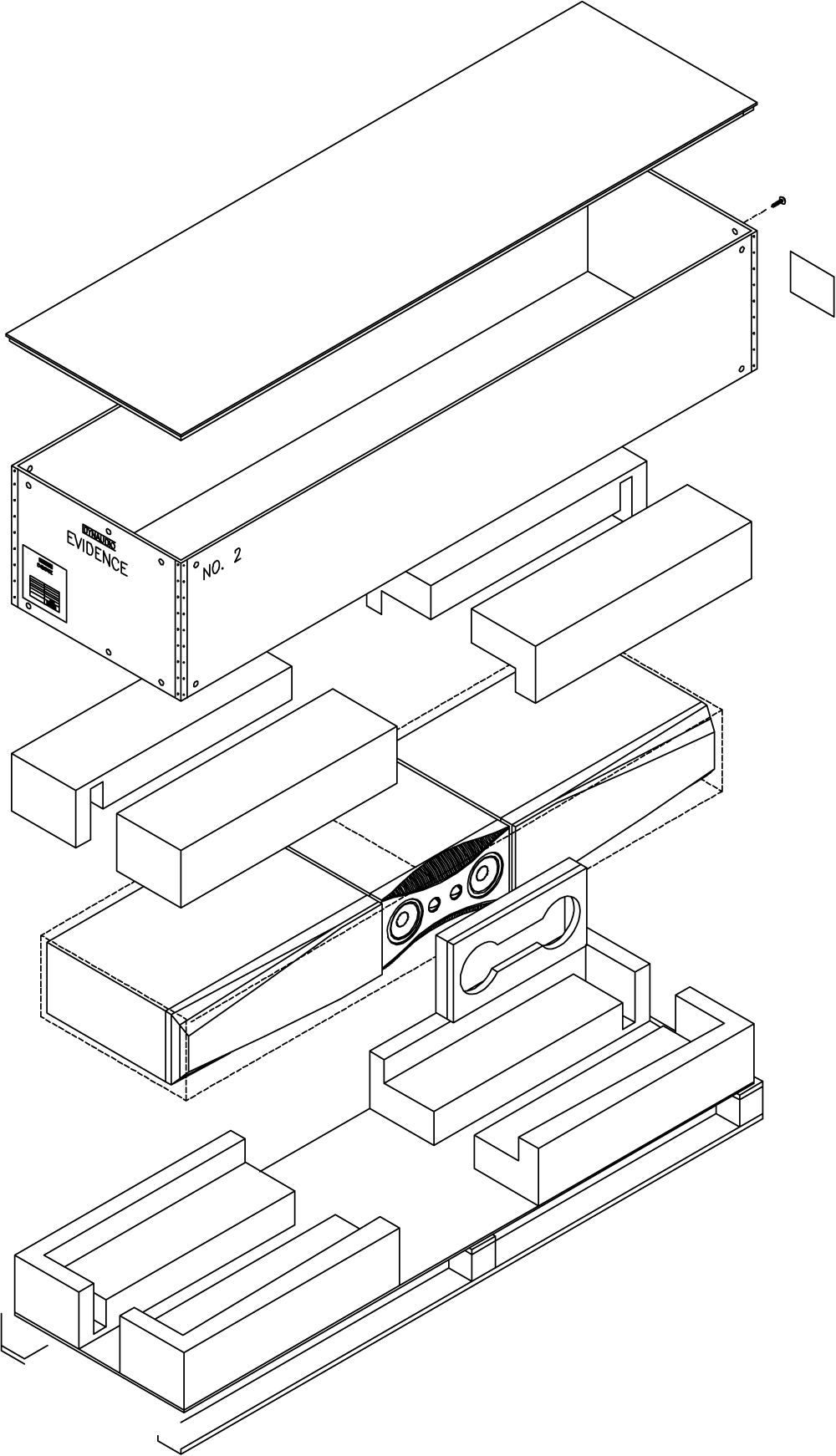
To unpack the Evidence Master loudspeakers:
- Please consult your Dynaudio dealer.
To unpack the Temptation and Center models:
- Lay the transport box flat on the floor.
- Remove the screws along the top plate, the top plate and the five safety pads.
- Remove the screws along the bottom plate.
- Carefully lift the sidewall frame.
- Carefully remove the loudspeaker by lifting it up horizontally.
- Turn the loudspeaker and slowly place it on its plinth.
- Remove the wrapping foil by lifting it on one end and unwrap it in a clock-wise motion. Do not use blades, cutters or any other sharp objects that will destroy the foil.
- Fix the sidewall frame on the bottom plate again.
- Place the wrapping and the safety pads back into the box and close the plate.
The wooden transport crates and custom cartons are intended for long-term use and should be used whenever the loudspeakers are to be transported, and as such they should be stored for future use.
Connecting
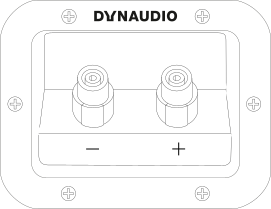
Connecting the loudspeakers
Connect a two-pole (+/-) loudspeaker cable to the binding posts, located at rear of the cabinet (see Figure 2). The high quality, gold plated binding posts can accommodate different connection systems:
- 4-mm-plugs (“banana plugs”): The pins can be put directly into the binding post without any tightening necessary.
- Cable spades: Un-tighten the binding posts, insert the spade into the opening, and secure the spade by tightening the posts.
- Bare wires: Un-tighten the binding posts and place the cable into the binding posts. Tighten the posts.
Note
- With every connection system, ensure that the contact is tight and has a proper contact area.
- Connectors with similar gold plating as the loudspeakers binding posts will typically offer the best results and remain corrosion-free.
- Please ensure that the positive and negative cables do not make contact with each other.
- Tighten the posts, and check the contact after a few days to make sure that it hasn’t loosened.
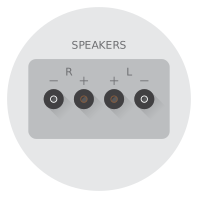
Connect the other cable ends to the loudspeaker outputs of your switched off power amp (see Figure 3).
Please make sure that both loudspeakers are connected properly. For a better distinction one of the two veins of most loudspeaker cables are marked.
- Connect the red marked post of the speaker to the red marked output of the amp.
- Connect the white or black marked post to the white or black marked output accordingly.
Bi-wiring/bi-amping
Dynaudio loudspeakers feature a carefully fine-tuned cross-over, optimised using selected parts and an advanced circuitry to achieve a truly balanced and smooth frequency response. Therefore, dividing the frequency sections through bi-wiring or bi-amping is not recommended.
Choice of loudspeaker cable
In general, quality cable products will yield a quality result. Dynaudio loudspeakers are designed to be very neutral and thus are not extremely suited to any particular type of cable. The choice of cable is as much a factor of matching the cable to the entire audio system. Please consult your Dynaudio dealer for information about compatible loudspeaker cables that will suit both your electronics and the Dynaudio loudspeakers.
Connecting surround speakers
When connecting a two-channel stereo system, only the right and left channels are connected to the amplifier.
In a surround set-up, centre, side or rear loudspeakers as well as a subwoofer are typically connected to provide for a multi-channel listening experience. Please refer to the amplifier’s owner manual for particular connection instructions and see chapter “Multi- channel loudspeaker setup” for further help.
Positioning
CAUTION
EXCESSIVE BRIGHTNESS
Direct sunlight or excessive brightness can affect the colour of any natural wood veneer (the structural integrity of the cabinet will not be affected).
To maintain the aesthetic quality of the loudspeakers for the long term, placing such in very warm, very cold, or very humid environments should be avoided.
Every room will have its own particular sound characteristics. Any room is also shaped and decorated uniquely, and therefore remains independent regarding options for positioning loudspeakers. The following steps are general suggestions that will make the correct positioning easier to achieve.
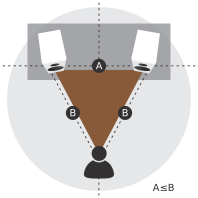
General recommendations
The following explanations refer to Figure 4.
- The distance between each loudspeaker and your listening position should be the same (B). Try to achieve an isosceles triangle.
- The distance between the loudspeakers should be the same or better slightly less than the distance between each loudspeakers and your listening position (A, B).
- The closer the listening position is in relation to the loudspeakers, the closer the speakers can be positioned to each other. As a starting point, it is recommended that the speakers be about 2 meters apart from each other for the best results (A).
- If the speakers are positioned too close to each other, the stereo image will not seem realistic; if that distance is too wide, the image may leave an acoustic hole in the middle.
- Paying attention to the image during listening tests will help dictate optimum placement during experimentation and set-up.
Distance to back and side walls
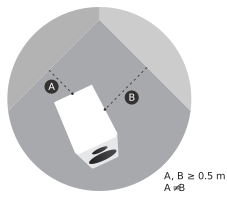
Every loudspeaker not only disperses sound energy directly into the room, but also to the side and even backwards. As a result, time-delayed reflections occur and add to the original music signal. Thus, when loudspeakers are positioned too close to walls, the sound quality can be restricted.
Dynaudio loudspeakers were developed to be placed free-standing, and therefore they reach their optimum performance when positioned as clear of any walls as possible.
- To reduce possible influences from the back and sidewalls, the distance to these boundaries should ideally not be less than 0.5 meter.
Floor-standing loudspeaker set-up
The floor-standing models feature a special base construction, which offers both an ideal performance and mechanical basis. Integrated into the base plinth are four individual spike assemblies. These stabilise the cabinet on an extremely small contact area, and therefore prevent any wobbling while offering optimal resonance control. The individually adjustable spikes allow levelling of the cabinet on uneven floors.
CAUTION
SPIKES WITH SHARP PEAKS
The sharp peaks of the spikes may cause injuries and damage sensitive surfaces like hardwood flooring or tile.
Be careful when handling the loudspeakers.
Place plates between the spikes and the surface to protect the underlying surface.
Note
The spike will not destroy a carpet surface.
Loudspeaker Toe-In
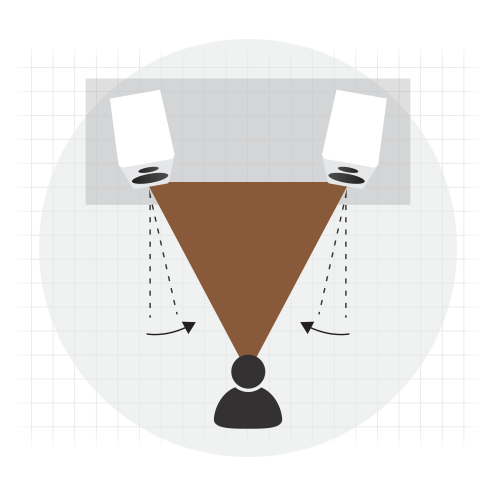
Depending on your personal listening environment and room dimensions, the loudspeakers may be angled in towards the listening area to focus the sound radiation. This positioning will typically improve imaging and is especially recommended by Dynaudio (see Figure 6).
Room and furniture influence
The sound quality of any loudspeaker is influenced by the furniture, wall materials and other objects in the listening room. For example, large rooms without much furniture and many clean, hard wall surfaces can give a bright and diffuse sound with diverse echoing frequencies. A room with thick carpet, curtains and soft furniture surfaces will give a slightly warmer, darker and less lively sound.
Grille
A cloth grille is included and can be affixed to the cabinet to help protect the drivers from dust and any other influences. The grille is acoustically optimised, but the highest sound quality levels will be attained without any grille covers in place during listening.
To remove the grille, gently pull the grille at all corners straight away from the front.
To fit the grille, line up the studs with the corresponding front baffle holes and gently push the grille in at all corners.
Multi-Channel Setup
Dynaudio loudspeaker models are designed to offer the most advanced performance in both stereo and multi-channel applications. When connecting a loudspeaker to a multi- channel setup, in general the same guidelines as mentioned in the text above will apply.
Note
When setting up a home theatre system, the loudspeakers should create a realistic soundstage with similar sound characteristics on each channel. It is therefore important that any speaker used in a multi-channel setup should match the same high quality level. This is especially important with regards to the centre channel loudspeaker, as this is a critical aspect of any multi-channel soundstage.
Loudspeakers for multi-channel setups
For a multi-channel setup, in addition to the two main (stereo) loudspeakers, additional channels (speakers) may be added to reproduce dialogue and surround effects.
Centre speaker
The centre is responsible for the information directed from the middle of the screen and should be positioned between the right and left main loudspeakers.
In a home theatre/surround setup, the centre supports the images and should be placed close to the screen.
Rear speakers
The rear speakers are responsible for the rear sound effects behind the listening position. Corresponding to the surround format 5.1, 6.1 or 7.1, you need to install additional speakers:
5.1: This is the standard multi-channel setup with two rear speakers. 6.1: An additional rear centre speaker is placed between the two rear speakers. 7.1: Two speakers are added on both sides between the front and rear speakers.
Subwoofer
Most often a subwoofer will be utilized for the LFE signal, especially in larger listening rooms. The position of the subwoofer will be dependent upon the size of the room and its acoustics. Dynaudio recommends placing the subwoofer close to the front speakers, but not too close to any walls, corners or furniture. This helps to sonically integrate the subwoofer in the existing surround channel setup.
Multi-channel loudspeaker setup
A complete multi-channel setup consists of following speakers:
- 1: Front (stereo) speakers
- 2: Centre speaker
- 3: Side speakers
- 4: Rear speakers
- 5: Subwoofer
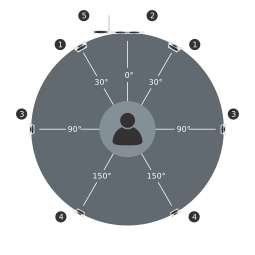
Because there are many different setup options – from 5.1 to 10.2 channel applications – and the fact that loudspeaker positioning will also depend upon the room’s shape, please consult your Dynaudio dealer for special applications and for placement options.
Running-in the loudspeakers
The moving parts of a newly manufactured Dynaudio loudspeaker have been acoustically checked after production, but nevertheless are not as flexible as they need to be for optimum results to be realized. The higher the quality of any driver system, the more demanding the loudspeaker will be regarding time for running-in the system.
A newly unpacked Dynaudio loudspeaker therefore requires several weeks running/ playing to reach its optimum performance capability. After that period, a couple of minutes before every listening session will be helpful to “warm up” the loudspeakers.
Power rating
Due to the construction and the driver technology Dynaudio loudspeakers can be driven with very high power levels. With a high quality amplifier, delivering undistorted signals, the speaker can achieve high levels without any compromises in sound quality.
Attention must be given to amplifiers with very low power and adjustable tone controls or switches. These types may soon overreach their own performance limits and may send distorted output signals to the speakers, compromising even high quality technology.
Any damage caused under such circumstances is not covered by the Dynaudio warranty and is easily avoided in the first place by consulting your Dynaudio dealer for advice regarding the choice of amplifier.
CAUTION
DISTORTED OUTPUT SIGNALS
Distorted output signals from too weak, defective or overloaded amplifiers may damage the loudspeakers.
Use high quality amplifiers only and run loudspeakers and amplifiers within specified power ratings.
Care and Maintenance
Dynaudio loudspeakers require no special treatment apart from the kind of careful handling you would normally apply to any high tech product in your home.
CAUTION
AGGRESSIVE CLEANING FLUIDS
All-in-one cleaning materials, aggressive cleaning fluids or special furniture polishes may damage the cabinet surface or other speaker parts.
Use a soft dry or slightly damp cloth when cleaning the cabinet and other plain parts.
Cleaning the loudspeakers
- Switch off all components of your system when cleaning any of these components.
- Avoid touching the tweeter domes as any change of their shape may have an impact on sound quality.
- Clean the cabinet and other plain parts with a soft dry or slightly damp cloth only.
- Remove dust on the woofer diaphragms with a fine furniture brush.
All materials used by Dynaudio are integrated with exceptional care. By taking care of your loudspeakers, you will preserve the finish and build quality for a very long time.
Warranty
Dynaudio provides a transferable limited 5 year manufacturer’s warranty. This warranty only covers faults or defects in material and production. Damage caused as a result of abuse, misuse or defective electronics is not covered by the warranty. All warranty claims must be accompanied by a copy of the original purchase invoice and warranties are only valid in the country or market of original origin or distribution. Should warranty service be required, it must be arranged for in the country of purchase by an authorized Dynaudio dealer.
All performance criteria are strictly controlled. In the whole production procedure – from raw materials to the final assembly – Dynaudio thoroughly inspects all parameters along every step of way.